Showing posts with label primer. Show all posts

Monday, October 20, 2008

The Primer #3: Joe Meek

A certain sphere of music criticism enjoys celebrating the underdog, those that sold nothing in their day but went on to be surface influential to those who conquered the world. It's not the same for producers, for whom the most progressively minded producers (not as in those who produce themselves, let's make clear) are still seeing themselves as bringing their ideas to the pop sphere, so whether it be Sam Philips, Phil Spector, Norman Whitfield, Arif Mardin, George Martin, Trevor Horn, Tony Visconti, Timbaland or whoever, these are all producers whose clients are instantly recognisable throughout the ages.

Joe Meek was as much a pop producer at heart as any of those, albeit for a shorter period (three UK number ones), yet his pioneering DIY and independently rebellious auteur image has given him the kind of outsider status that cults thrive on. Following the close friends, associates and fans interviewing documentary released to art festival showings earlier this year A Life In The Death Of Joe Meek comes the premiere as part of the London Film Festival on 25th October and again on the 28th of Telstar, the film of the well regarded play co-written, adapted and directed by Nick Moran, starring acclaimed musical actor Con O'Neill as Meek and also featuring Kevin Spacey, Pam Ferris, Ralf Little, James Cordon, Rita Tushingham, Nigel Harman, erm, Carl Barat and Justin Hawkins. High time, then, to look into why he's so revered.

Robert George Meek, born 1929 in Newent, Forest Of Dean (home to the National Birds of Prey Centre and Europe's largest cul-de-sac) had an early interest in putting on a show, staging magic shows for children and being dressed as a girl by his mother. It was a fascination with electrics that was his real first love, though, building his own gadgets by taking the backs of old radios and record players, rigging up nascent PAs and setting up a mobile DJing kit. A National Service spell in the RAF as a radar technician helped his interest along. After demob, he bought an acetate disc cutter and in 1953 moved to London to become a sound engineer for a radio production company that made programming for Radio Luxembourg and then a studio recording engineer, and would surreptitously add effects and tricks onto recordings regardless of whether he'd been asked to. One such ploy saw him mess with the final mix of Humphrey Lyttleton's Bad Penny Blues, putting the piano part to the front and distorting the bass. It became trad jazz's first top 20 single. By day working in studios, he set up a small recording facility in his flat where he'd record tone deaf demos of songs he'd written, mostly inspired by his point of obsession hero Buddy Holly.

After being sacked from Lansdowne Recording Studios (where the Sex Pistols would later record Anarchy In The UK, following any number of 60s British Invaders) due to a clash of personalities with the owner, in 1960 Meek co-founded Triumph Records, possibly the first British independent label. One of its first releases was his own I Hear a New World - An Outer Space Music Fantasy. Playing on Meek's penchant for outer space and equipment manipulation and largely made flesh by The Blue Men, an adapted skiffle group, it was Meek's largely instrumental attempt "to create a picture in music of what could be up there in outer space", a blend of the band, found sounds, electronic pulses and special effects that was less late 50s kitsch the subject might suggest than presaging psychedelia and Eno ambient. Due to finance issues only the first side came out as an EP, the whole album not fully issued until 1991 (the 2002 reissue has a half hour interview with Meek about his processes added).

Joe Meek/The Blue Men - I Hear A New World

There were more conventional releases, most notably teenage fantasy Angela Jones by Michael Cox, heavily supported by Jack Good's television programmes and making number seven, arguably not going higher due to Triumph's inability to press enough copies through independent pressing plants. The label proved to be somewhat short of cost effective, but a rich toy emporter benefactor stepped in and enabled Meek to set up RGM Sound Ltd and upgrade both studio and flat to a premises above a leather goods shop on 304 Holloway Road, N7.
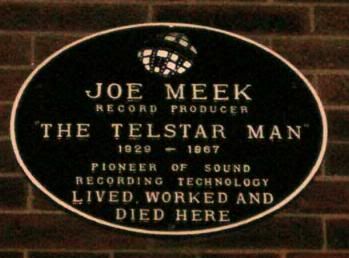

Photo adapted for size from Houseplant Picture Studio, which also reveals the leather goods shop is now a cycle store

Holloway Road wasn't the most comfortable of settings, being on the third floor, but Meek knew he now had the room and wherewithal to do what he pleased with the sounds he was trying to create. He knew he couldn't create them without a sideman, though, and through publisher auditions met Geoff Goddard, a Royal Academy of Music trained pianist whom Meek briefly attempted to launch as Anton Hollywood. It was as a writer he'd become more successful, not least when the first release from the new studios became a number one. John Leyton was a rising young actor (in fact he briefly appears in Telstar) who like many a successful with teenagers actor of the day was hastened towards the studio, and after a couple of flops Goddard offered the orchestral death disc Johnny Remember Me, which he would claim had been written with the aid of a seance. The recording session itself leant itself to many a Meek legend, with vocals recorded in the bathroom and a string section arranged on the stairs for the acoustics necessary to create the eerie, echoey sound Meek had made his own, plus the then in-house backing band The Outlaws, including future Dave cohort Chas Hodges. At the time Leyton was appearing in ITV department store drama Harpers West One as a character called Johnny St. Cyr and his manager arranged for the song to be mock-performed on the show, with the required chart results.

John Leyton - Johnny Remember Me

Nobody had heard a hit quite like this before, especially not one that clocked up five weeks atop the chart, and Meek's setup became an industry talking point, as much anti ("a recording studio is the place to record" one columnist railed) as pro, Meek claiming "I make records to entertain the public, not square connoisseurs who just don’t know”. A lot of his recordings weren't hits at all, but most were deeply fascinating. Overseen by a pair of men deeply fascinated by the occult and taken to visiting graveyards and haunting sites overnight, Screaming Lord Sutch, whose stage antics essentially invented Alice Cooper, recorded and plotted outlandish publicity stunts with Joe, and The Moontrekkers' Night Of The Vampire was banned by the BBC and has been credited with inventing goth about two decades too early (the band hadn't been instrumental until Meek worked with them, although the singer's sacking is something we doubt Rod Stewart has had much cause to bemoan lately). Some of these recordings were known to have been rejected by labels and mastertape cutting engineers as they would damage domestic speakers.

The Moontrekkers - Night Of The Vampire

For a good period of this time Meek had his next big success under his nose but hadn't realised it until his latest in-house band were asked to back Billy Fury on tour. The Tornados - Alan Caddy on lead guitar, Heinz Burt on bass, Matt Bellamy of Muse's father George on rhythm guitar, Roger Lavern on keyboards and drummer Clem Cattini (who went on to hold the record for most UK number ones played on, appearing on 44 chart toppers ranging from It's Not Unusual, The Sun Ain't Gonna Shine Anymore and You Don't Have to Say You Love Me to Grandad, Two Little Boys and Ernie The Fastest Milkman In The West) - were the guinea pigs for Meek's tribute to the AT&T communications satellite Telstar, which went into orbit in July 1962, five weeks before the single named after it was released. Making heavy use of Goddard's clavioline keyboard and inspired by I Hear A New World's advances, it not only topped the UK chart for five weeks but the Billboard Hot 100 for three, making the Tornados the first UK band to have a US number one, estimated worldwide sales standing at five million. Famously, it was also one of Margaret Thatcher's Desert Island Discs. The band did have other hits, Globetrotter reaching number five and Robot nineteen, but Meek was by this time high on the hog and buying ever more equipment for the studio, at least until French composer, Jean Ledrut accused Meek of plagiarism, claiming that the tune of Telstar had been copied from his own earlier work Le Marche d'Austerlitz. It is now thought very unlikely that Meek would have been aware of Ledrut, but the resultant lawsuit prevented him from receiving any further royalties until 1968, by which time it was too late.

The Tornados - Telstar

The Tornados' German bass player, Heinz Burt, wasn't allowed to merely drift away, however. Homosexual Meek - a lot of his depression and paranoia has been attributed to his feelings over his sexual proclivities, not legalised in the UK until 1967 - had taken an unconsummated shine to Burt, and when Goddard came up with Eddie Cochran tribute Just Like Eddie Meek, who had already split Burt from both band and professional surname, persuaded him to record it with yet another Meek band, The Saints, plus Outlaws guitarist Ritchie Blackmore (later of Deep Purple and Rainbow). A number five in August 1963, Meek was now in position where he could independently record a string of unknowns and sell the results to the major labels for big money, meaning the Meek rarities market is almost as crowded as the Northern Soul catalogue.

On November 11th 1963 Meek, who was as openly homosexual as the times would allow, was arrested for "importuning for immoral purposes" in a gents near the studio and fined £15, a possible set up and certainly one that would lead to incidents of blackmail which didn't help his mental state or legendary fits of temper. Additionally the beat group era who were more reliant on self-written songs and the pure pop of melody rather than svengali producers was on his tail with the rise of the Beatles and Merseybeat, although one such group, The Honeycombs, came under Meek's auspices. Famed at the time for having a female drummer, one Honey Lantree who supposedly inspired Karen Carpenter to take up the drums, they provided him with his last UK number one, the stomping Have I The Right featuring a bass drum sound achieved by the group stamping on the stairs of the studio, the underside of which had been attached four microphones.

However, the success came at a personal price - Geoff Goddard launched legal proceedings claiming that the prolific Ken Howard and Alan Blaikley had plagirised his own Give Me The Chance, and not only lost but saw Meek side against him. Goddard left Holloway Road employment and faded out of the business, taking a job in catering at Reading University where he ended up working in the kitchens (his later colleagues included two hard-up students who became Yan and Noble of British Sea Power, who would write The Lonely about him) and died in May 2000.

Meek's professional life was coming apart at the seams. Tom Jones, who he'd auditioned and turned down, was having hits. The Tornados and Heinz were fading away while the Honeycombs fell apart within two years. The deals Meek signed with major labels were full of loopholes and financing wasn't there. Meek was heavily into pills, including LSD, and seances, an unwise combination. Some of his music was as inventive as ever, moving on to psychedelia, Mod and freakbeat...

The Syndicats - Crawdaddy Simone
Glenda Collins - It's Hard To Believe It

...and after Merseybeat band The Cryin' Shames took a Meek produced cover of The Drifters' Please Stay to the top thirty in 1966 Brian Epstein supposedly offered his more famous charges to Meek with no dice, and when a London visiting Phil Spector called to express his love of the sound an increasingly paranoid Meek, who already believed Decca were bugging the premises, angrily accused Spector of stealing his ideas before hanging up. Meek ended up placing listening devices around the studio in case musicians were talking about him. At one point he was found beaten up and unconscious in his car, perhaps related to gangland threats against the Tornados as much as those around his sexuality.

When in January 1967 police found the body of Bernard Oliver, an alleged rent boy and past associate, mutilated and disposed of in a suitcase, Meek was alarmed when reports sugested police would be interviewing all known homosexuals in the city. On 3rd February 1967, the eighth anniversary of his hero Buddy Holly's death, heavily in debt and drug-paranoid, Meek was attempting to record his latest studio assistant when landlady Violet Shenton was called up, Meek believed to have been on the verge of being thrown out for non-payment of rent. Meek had a single barreled shotgun, registered to Heinz Burt and confiscated by Meek some time before when Burt left after a brief period living in the property. He now retrieved it and used it to blast Shenton in the back of the head, before turning it on himself. He was subsequently buried at Newent Cemetery.

Meek's legacy took some time to reassert itself, largely through the work of collectors and obscurists from the late 70s onwards. A 1991 BBC2 Arena documentary, The Strange Story Of Joe Meek (which we've found on torrent sites if you're interested) is credited with kickstarting the renaissance as well as a reissue and excavation program which continues. His influence is felt across music, from pop producers to leftfield beatmakers, both Orbital and Saint Etienne regarding him as a major inspiration. He pioneered effects in overdubbing, tape manipulation, miking, distortion, compression, reverb, instrument seperation, recording of rhythm sections, composite recording and sampling found sounds, always taking the sound spectrum first ahead of the tune, single-mindedly searching for a unique sonic signature for each record, these out of the way, supposedly unworkable advances now treated as standard. Unlike his contemporary Phil Spector, he wouldn't hire great numbers of musicians and backing singers to create the overwhelming effect but would record individually and mix together as he wanted. Meek turns up as a character in acclaimed gangland novel The Long Firm - writer Jake Arnott has a cameo role in the film - and songs have been written in his honour by the likes of Wreckless Eric, Graham Parker and, if you believe her story of the background to her single A Change Would Do You Good, Sheryl Crow. Meek may not be the most famous name outside certain circles, but his working methods were as groundbreaking as his life was fraught.

Further reading:
The Joe Meek Appreciation Society, formed in 1991, is "dedicated to keeping Joe Meek's name and his musical legacy alive" and runs a full membership scheme as well as keeping track on all current movements. This, oddly, is not to be confused with Joe Meek RGMAS. Meanwhile the dual language The Joe Meek Page attempts an entire discography. There's a few newspaper and magazine pieces we've trawled to write the above, but Jon Savage's essay for Observer Music Monthly on Meek's homosexuality, with reference to celebrated Tornados B-side Do You Come Here Often?, adds extra background for the times.

BUYER'S GUIDE: As stated somewhere in there, new discoveries are turning up all the time, the so-called "Tea Chest demos" as all his tapes were kept in 67 tea chests still being excavated - 1850 such tapes recently failed to sell at general auction despite including in the haul early recordings of Tom Jones, Gene Vincent and Billy Fury, plus David Bowie's first band The Konrads. Joe Meek: The RGM Legacy - Portrait of a Genius is a four disc box set that attempts a whole career overview, including rarities, demos, interview clips and alternate versions, plus liner notes by Bob Stanley. Telstar - The Hits Of Joe Meek reduces the 'hits' to two discs and 36 tracks on Sanctuary's budget promotion, while It's Hard To Believe It - The Amazing World Of Joe Meek is a more judiciously cherrypicked 21 track compilation. 56 track Joe Meek: The Alchemist of Pop fits somewhere in the middle. The EP Collection recreates twelve four-track EPs, including Telstar. I Hear A New World is reissued every so often. Let's Go - Joe Meek's Girls shows he could work really well with female singers, including the Sharades, the trio we singled out in the girl group Primer, while Joe Meek Freak Beat: You're Holding Me Down demonstrates that as the 60s wore on he didn't lose all his rampaging touch.

Monday, July 07, 2008

The Primer #2: reggae like it used to be


The full scale ridiculousness of a pasty bloke from Jesus Christ Superstar issuing a clarion call for old style reggae is that this was released in 1976, slap bang in the middle of what is now commonly known as 'the golden age of reggae'. What actually spurred us on to this, thogugh, was seeing a TV advert for something called Massive Reggae, posited as all the irie you need for your summer. And who have they picked off its tracklisting as its selling points? Shaggy, Shabba Ranks, Ini Kamoze, longtime Moyles punchline Chaka Demus & Pliers... basically Jamaicans influenced by hip hop to form a crossover version of dancehall, which was invented at the end of the 1970s and has a arm's length relationship with roots reggae. While roots is great summer music and none of the above really "reggae Beethoven" - thank you, Paul - it's misleading to throw them in as keepers of the Bob Marley flame. Indeed, there's far too many flames burning from the 'golden age' that aren't treated with such reverence, and it's time we had a look at them.

Quick timeline to start, because reggae certainly didn't intend to become the world's dominant Caribbean musical force. So first there was calypso, which originated at the start of the 20th century in colonial Trinidad, then there was Mento, which fused it with Jamaica's indigenous folk in the 1950s. When American rhythm and blues started ekeing in later that decade the sound system was invented, and when jazz came over the fusion invented ska. In truth ska is more our area of expertise, and we will come back to it one day. (Note to Universal: please commission a compilation entitled Maximum Ska which the TV advert for features No Doubt, Less Than Jake, the Holloways and Bad Manners so we have an excuse. Ta.) In the early 60s ska rhythms evolved to give space to vocalists, making stars of the likes of Desmond Dekker and Toots Hibbert, and that's where an Englishman called Chris Blackwell first made an impact. Blackwell was based in Jamaica as aide de camp to the island's governor and developed an interest in its indigenous music, so much so that he formed a label called Island Records in 1959 to record the emergent ska sounds. When he moved back to Britain in 1962 he continued selling his recordings, and two years later brought over eighteen year old bluebeat singer Millie Small and her version of R&B song My Boy Lollipop, a UK and US number two.

Even as Island later began signing white British acts the Jamaican spirit was still foremost in the label's priorities through the rise of the DJ and selector. The DJ in Jamaica is what we would know as an MC, and it was prominent DJs who invented toasting, which got taken back by the likes of Kool Herc to Bronx street parties where it developed into rap. The influence of Rastafarian culture led to the slower tempo and bassier version of ska that was given the name rocksteady, derived from an Alton Ellis song but not a universally popular term.

Where the term reggae comes from depends on who you talk to. Influential singer and producer Clancy Eccles claims to have coined it as an answer to the slang term streggae ("loose woman"), although Toots Hibbert clams he came up with it; hugely popular early 60s ska star Derrick Morgan says producer Bunny Lee used it as a term of onomatopoeia for the sound of the downstroke of the rhythm guitar in the form's development; others say it evolved from terms in Latin or Spanish. Whatever. Reggae in its early form was essentially rocksteady with more of a US soul influence and at an even slower pace - exotic smokes may have been partly responsible, we couldn't possibly say - with a greater emphasis on the organ and rhythm guitar ahead of the bass. Bunny Lee was the first producer to set this sound in stone, and among the first to make the crossover were a vocal trio who'd made their names in ska and continued through rocksteady, formed in 1962 by three friends who'd met through the vocal scene, Winston 'Peter Tosh' Macintosh, Neville 'Bunny Wailer' Livingstone and Robert 'Bob Marley' Marley.

The Wailers - Concrete Jungle

When the Wailers split in 1974 after British breakthroughs Catch A Fire and Burnin', put out by Island through the band's own Tuff Gong, Bob Marley formed Bob Marley and the Wailers with the Wailers Band, a backing outfit formed by brothers Aston and Carlton Barrett and featuring Bob's wife Rita as one of backing singers the I Threes, and became stratospheric with that year's Natty Dread, the accompanying tour and celebrated London Lyceum gig in 1975, plus chiefly 1977's Exodus and 1978's Kaya. The story is far too famous and elongated to go into in this format, but it was made possible by Blackwell's label and personal management, making the sound slightly more westernised through judicious overdubs to attract the overseas audience and frankly taking a chance on what was seen as, if not a novelty, then very much an underground thing at the time, a form of the earlier Jamaican imports beloved of skinheads and mods in the mid-60s where the only hits were novelties such as Max Romeo's Wet Dream.

Leaving aside international campaigns, Marley's other mentor on the road to reggae Damascus was an altogether more complex character. The Wailers Band mostly comprised members of the Upsetters, who had been the studio band of Lee 'Scratch' Perry. Perry started as an associate of Coxsone Dodd's sound system and later his Studio One ska label and studio, described as "the Motown of Jamaica". After they fell out Perry formed the Upsetter label in 1968, his first single, People Funny Boy, seen as a key milestone in reggae's development. In these years he worked with many of the island's big names, developing innovative production techniques involving layering, sound effects and mike techniques as well as a singular character. In 1973 he built Black Ark Studios to produce the Wailers among others and creating a sound all of his own, also exhibited on a series of his own dub-heavy records. Eventually stress and outside influences took their toll and he supposedly burned the place to the ground in 1979, moving abroad to make a series of erratic records before a critical resurgence working alongside Adrian Sherwood and Mad Professor. He now lives in Switzerland, accuses Chris Blackwell of being a vampire and is soon to release an album produced by Andrew WK.

Lee Scratch Perry & The Upsetters - Dread Lion

It's not in chronological order, but let's go into a sidebar on dub now we've brought it up. Coming out of the practice of making instrumental B-sides, the dub sound was essentially the forerunner of the remix, manipulating the master tapes of recordings usually by removing or altering the vocals to emphasise the bass and drum 'riddim', usually using echo and reverb, using the mixing desk as an instrument. Perry, whose 1973 Blackboard Jungle Dub is widely recognised as the first proper dub-only album, vies for invention of the form with King Tubby, born Osbourne Ruddock, a former sound system engineer and radio repairer who made his name as the go-to guy when weather (or jealous rivals) affected the electrics. Becoming a leading producer, he stumbled across dub's building blocks when playing with the desk attempting to make instrumental versions for toasters and went on to use his electronical background make a living out of building studio equipment for the means to alter the recordings. Although it fell out of favour in Jamaica at the end of the 70s dub carried on largely in Britain and as well as the art of the remix has been cited as a major influence on post-punk, house, techno, drum and bass, trip hop, UK garage and latterly dubstep.

Harry Mudie & King Tubby - Dub For The Dread

So clearly there's a dual speed going on in reggae, with Perry and Tubby reshaping its sound while a group of singers infiltrate the mainstream. Jimmy Cliff was a Perry client who broke through as a ska singer in the mid-60s and signed to Island. 1970's Wonderful World, Beautiful People was huge internationally, clearing a path for the film in which he starred as well as curating the soundtrack, 1972's The Harder They Come, in which he portrayed a singer forced into lawlessness in his quest for stardom, giving him a westernised 'outsider' image, and which became a cult hit and is credited with launching reggae in America when released there a year later. Last year the title track was adopted as a personal anthem by David Cameron. It had previously been politically connected with Nicaragua's Sandinistas, who Thatcher was virulently against. You work it out.

Jimmy Cliff - The Harder They Come

In the mid-70s a new breed of toasters/deejays appeared, influenced by pioneer U-Roy. Alongside Dillinger and I-Roy was Big Youth, who teamed up in 1972 with Gussie Clarke, a teenaged producer who was seen as more in tune with Kingston at street level than most. This led to a string of domestic hits before 1973 album Screaming Target, utilising the then common practice of borrowing someone else's backing track, here the likes of Gregory Isaacs and Leroy Smart and on the title track No No No, KC White's cover of Dawn Penn's original which Penn would take top ten internationally in 1992. He continued having big hits and extending his range in both vocal and producer until his style was overtaken, but he's still going. Watch how this develops from a critique of a famous Clint Eastwood character to a plea for literacy.

Big Youth - Screaming Target

Eric Clapton's 1974 cover of Marley's I Shot the Sheriff is cited as reggae's first breakthrough into whitey's rockist world, but John Peel was already playing all forms of roots reggae on his own show. A particular Peel favourite was Burning Spear. Winston Rodney originally called his band after the nickname of the first independent Prime Minister and President of Kenya, but eventually it stuck to him alone. Working with Studio One's Coxsone Dodd - who, it should be noted, discovered the Wailers and was pretty much the leading figure in ska and rocksteady - he developed a style based on Rastafarianism, black history and social concerns based on the oratory of Marcus Garvey. Burning Spear is still recording and has been nominated for eleven Best Reggae Album Grammys between 1986 and this year, but it's his mid-70s work that stands up the best,

Burning Spear - Marcus Garvey

More roots stuff and another album high watermark, 1976's The Heart Of The Congos. The Congos were a vocal trio who hooked up with Lee Perry in Black Ark, reggae historian Steve Barrow referring to the result as "the most consistently brilliant album of Scratch's entire career". They never recaptured its spirit and Perry's dispute with European label Virgin affected its overseas chances - indeed it wasn't properly issued in the UK until 1980, and that only when The Beat decided to make it the first release on their own Go Feet imprint - but it charms most who hear it.

The Congos - Fisherman

If Chris Blackwell, and later Richard Branson at Virgin, were getting the records out in Britain, Don Letts was alongside Peel finding them an audience. A first-generation black Briton of Jamaican descent, Letts ran a clothes store in the Kings Road where the mixture of Vivienne Westwood-inspired gear and Letts' roots and dub playlist attracted the punk in-crowd, as well as Marley whenever he was over (the environment inspired his Punky Reggae Party). The shop's accountant opened The Roxy nightclub in Covent Garden, which attracted much live punk trade, and invited Letts to become resident DJ, and with little or no punk records to play he transposed his reggae records to the new setting. The bass-heavy sounds, social soundbite lyrics and rebel image struck a chord. It was in fact in the UK that the last few roots reggae-inspired shifts would take place - lovers rock was a variant of rockers reggae coined in South London as an apolitical, soulful version, taken up by Aswad and Janet Kay. Ska lay dormat throughout this era as a mod memory until lapsed punks such as Jerry Dammers picked up on its fast rhythms and developed 2 Tone.

A Letts favourite was Culture, a vocal trio chiefly centring on Joseph Hill's vocals who worked with the Mighty Two, producer Joe Gibbs and engineer Errol Thompson. Their first and best album Two Sevens Clash based its title and title track on a Garvey prediction that when the sevens met on 7/7/7 there would be apocalyptic chaos, a premonition that caught on so much that many Jamaican businesses and schools closed for the day. Culture were an embodiment of 'rockers reggae', a subgenre named after the sound system of melodica-toting dub legend Augustus Pablo and originated by the rhythm section of Lowell Dunbar and Robert Shakespeare, better known as Sly & Robbie. (See also: Gregory Isacs, Horace Andy, Junior Murvin, Dennis Brown)

Culture - Two Sevens Clash

Also often grouped as rockers reggae spearheads are Black Uhuru, who formulated a more harmonic, Rastaised form and domestically took over where Marley left off when he went off to conquer the world. Like the Wailers they were a tight vocal outfit backing a strong lead voice but were more directly attuned to Jamaican politics and the endemic street violence as well as Garvey and religion. Their key work was released at the start of the Eighties, when they also toured with the Clash and the Police.

Black Uhuru - Happiness

By the time Black Uhuru were striking big original reggae was on the downturn. Marley's sound had arguably been watered down for wider acceptance and aside from him the sound never really made the international breakthrough many had put their money on, instead leading to many cult hits and the odd one-off (Althea & Donna, anyone?), and when Marley died in 1981 labels downgraded their interest in Jamaican reggae. A lot of established producers left for the US and UK largely due to the rising tide of violence, and as Rastafarianism declined in influence the young people either looked to America for inspiration or got into 'slackness', a more directly crude lyrical form. Slackness thrived in dancehall, a style that developed largely through Barrington Levy's work, a faster, digitalised form which was taken overground briefly in the early 90s, shifted into a more upfront, sometimes violent form by the likes of Buju Banton, Bounty Killer and Beenie Man and had a mini-revival a few years ago with Sean Paul and Elephant Man. Meanwhile ragga was invented in the mid-80s and was an instant hit, more toasting-centric than the singing of dancehall but otherwise much the same. Shabba Ranks is ragga, Shaggy is dancehall. Write that down. Latin America turned dancehall/ragga into reggaeton with the addition of hip hop and its own indigenous dance cultures - Daddy Yankee's Gasolina, number five in Britain in 2004, was its only real international crossover, although it retains a fervent fanbase in areas of America. Meanwhile within Jamaica Luciano's conscious roots and Bob's youngest offspring, double Grammy-winning toaster Damien Marley (2005's Welcome To Jamrock an increasingly rare European radio crossover) are attempting to reinvent what came before. In whatever format, the original reggae remains timeless and of itself to this day.

Paul Nicholas is currently appearing in The Royal Today and has launched a community arts centre in Blackpool.


BUYER'S GUIDE: Two reissue back catalogues to devour voraciously are those of Trojan Records and Blood & Fire records. Trojan was there at the time, issuing the Upsetters, Desmond Dekker and Dave & Ansell Collins among many others. The imprint was bought out in the mid-80s independently, then this decade was bought by Sanctuary and in turn Universal, and brings out a good fifty tracks at a time every so often. Blood And Fire was started in 1985 by five roots enthusiasts, including leading reggae historian Steve Barrow with the aid of leading not-reggae singer Mick Hucknall and until stalling last year issued a lot of hard to find albums and cheapo compilations. For those we write about: Bob Marley compilations are ten a penny, and just occasionally they're even printed without Marley's name atop plain Wailers material - Gold is the best mix of family favourites and judicious cuts from the period in question. Our choice of track is taken from Catch A Fire. Super Ape by Lee 'Scratch' Perry will never go out of print, probably, although a good place to start with the madness is the three disc Arkology. As an introduction to the headspinning world of King Tubby dub Father Of Dub does the business; Harry Mudie & King Tubby In Dub Conference Volume One isn't on Amazon at the moment. The Harder They Come soundtrack includes just three Jimmy Cliff songs alongside the likes of Toots & The Maytals, the Slickers and Desmond Dekker. Some artist albums: Big Youth's Screaming Target, Burning Spear's Marcus Garvey packaged alongside follow-up Garvey's Ghost, The Heart Of The Congos, Culture's Two Sevens Clash in a title-defying thirtieth anniversary reissue (for further vocal/roots work of the time, try Firehouse Rock by Wailing Souls) and Black Uhuru's Sinsemilla. (Thanks to Bill for some touch-up advice)

Tuesday, October 30, 2007

The Primer #1: girl groups

Yes, it's another new irregular feature we've no hope of maintaining properly. What's going to happen in each Primer selection is we'll isolate one genre or trend of music that's shaped pop and rock since its heyday and provide ten or so mp3 pieces of evidence to demonstrate its contemporary influence, kind of an Illustrated Guide (and those are continuing, one later this month) for musical categorisations.

And girl groups, or at least what we know as the classic girl group sound, is the little recognised drive behind quite a bit of the music we hear today. Although there were the Andrews Sisters well before and the Three Degrees afterwards, that era between 1961 and 1966 (the timespan of the Ronettes as performers, and also the Chiffons' formation to the Shangri-Las' label going under) saw an explosion in the harmonic structure allied to high-end production and teenage melodrama. As David Quantick has pointed out, girl groups are better than their male equivalents because, with few exceptions (go on, have the Temptations), the girls get the better writers and more forward-thinking producers, what with Spector, Gordy, Goffin & King, Ellie Greenwich and so forth - something that carries a direct route through to Xenomania and Richard X today. ABBA, Bruce Springsteen, the Stooges, the New York Dolls, the Ramones, the Smiths and Blondie all eagerly credited the era as direct inspirations, and the chain carries right on through new wave's harmonic soul appropriations, C86's naive sweetness (and then to your Camera Obscuras, Lucky Souls and Monkey Swallows The Universes of today), Stock Aitken & Waterman, R&B groups and now Amy Winehouse blathering about spending the best part of a year in bed listening to the Shangri-Las and several unconnected attempts in the UK and US to revive the basic structure of the girl groups (the Pipettes, the Revelations, The God Damn Doo Wop Band, the Dansettes, Tralala, the Shalitas). So clearly this movement, started as much in playgrounds and high school refrectories as Pentecostal choirs, has marked out its own territory over the years since it dissolved from the mainstream conscious, but what did it actually entail? Here's your primer.


The first female vocal harmony groups in this methodology, both charting for the first time in 1957, are agreed to be the Bobbettes, whose first single Mr Lee made the top ten but was their sole top 50 hit (they later appeared on the Dr strangelove soundtrack) and the Chantels, the first black group to be successful with two top 20 singles. Interestingly, both were five-pieces. The first to become real stars were the Shirelles, four New Jerseyites who defined the sound with R&B/pop crossover stylings, yearning innocence and a transformation of doo-wop's principles for the rock'n'roll age. In 1960 they became the first girl group to have a Billboard number one (number four in the UK) with Goffin & King's Will You Still Love Me Tomorrow. Their next six records all went top ten in the US, including another number one in Soldier Boy, while the Beatles covered both Baby It's You and this one.

The Shirelles - Boys

If we take the Supremes as a straight-up soul act, the most celebrated of all the groups were the Ronettes, Veronica and Estelle Bennett and their cousin Nedra Talley. Spotted in 1961, they were styled as the bad girls of the era and were the first to be pictured on their record sleeves, eventually hooking up with Phil Spector and hitting paydirt straight off with Be My Baby, a song which has long outlived its #2 US #4 UK chart placings just going on the number of songs that have copied its storming Hal Blaine drum intro. In actual fact the band were never as commercially successful as their reputation would suggest, Baby I Love You peaking at 24 on Billboard and 11 here, Walking In The Rain 23 in America and nowhere in Britain. By the time they opened for the Beatles on their last American tour just before splitting in 1966 Ronnie had been spirited away by Spector into six years of tortuous married life.

The Ronettes - He Did It

If the Ronettes were the emotionally direct big boot and bouffant wearers, the Shangri-Las were the projects' no less outwardly feisty but tear-stained with friends college diarists. Formed at school in Queens, NY in 1963, the identical Ganser twins and Weiss sisters (Betty rarely appeared in public with the other three), the signed a year later to Red Bird Records, Lieber & Stoller's label which had just taken the Dixie Cups, another two sisters and a cousin group, to number one with Chapel Of Love, initially written by Phil Spector, Jeff Barry and Ellie Greenwich for the Ronettes. Greenwich and Barry contacted local songwriter George 'Shadow' Morton with a challenge to come up with a song for the new girls, and when the result Remember (Walking In The Sand) reached the Billboard top five (with a teenage Billy Joel on piano) he was given them as his personal fiefdom. What followed was the construction of a house sound every bit as far-thinking and extraordinary as the Wall Of Sound, laced with lyrics about loneliness and alienation, which sent death disc Leader Of The Pack to Billboard number one and UK 11 (number three on 1972 reissue) the same year. A couple more top ten singles followed, but Red Bird folded in 1966 and the band split in 1968, barely a penny to their name after many royalty disputes, although they attempted to reform in 1977 with Mary Weiss citing Patti Smith as an influence, foundering when label bosses preferred them to become a disco outfit.

The Shangri-Las - I Can Never Go Home Anymore

So, if all movements have a Big Four, a rule of thumb we've just invented but we think you'll find works out, who should be fourth up? There's the Chiffons, makers of another Billboard topper, He's So Fine, and still going with original leader Judy Craig; the Velvelettes, whose Needle In A Haystack is the only song to appear in Nick Hornby's 31 Songs that John Peel agreed with; the Marvelettes, Motown's first girl group whose top 20 career spanned 1961 to 1968 including the original Please Mr Postman; and the Cookies, the original line-up of whom were bequeathed to Ray Charles and recorded under at least three pseudonyms. But for our purposes we're running with the Crystals, Phil Spector's other girls and a band whose machinations need some concentration on your part. It was they who recorded the infamous He Hit Me (And It Felt Like A Kiss), written by Goffin & King about Little Eva's reaction to partner abuse. It wasn't a hit, and in desperation Spector recorded Darlene Love and the Blossoms' He's A Rebel, credited it to the Crystals and watched it top the Billboard chart, much to the original band's surprise. The follow-up Da Doo Ron Ron was the Blossoms with Crystal LaLa Brooks on lead, and it wasn't until the fourth one on Then He Kissed Me that the original Crystals got to record as themselves. Their last hit came in 1964, the end in 1967. This was the follow-up to He's A Rebel, and thus Blossoms-as-Crystals. It's also been credited as the song with which Spector first perfected the Wall Of Sound.

The Crystals - He's Sure The Boy I Love

Despite the decent careers of many of those namechecked above, the image of the girl group has become fixed as a svengali'd group of high school kids getting out one hit and then disappearing in a welter of minor singles and disputes. While it's not exactly a great reflection upon the movement's work, there were quite a few great one-shot then cast into obscurity bands, perhaps none greater than the Murmaids. A teenage LA trio including two sisters, they were picked up by maverick producer and impresario Kim Fowley who'd been behind B Bumble & The Stingers' UK number one Nut Rocker and David Gates, who went on to front soft rockers Bread, wrote for them this standout, which reached #3 in America in 1963.

The Murmaids - Popsicles & Icicles

Inevitably with such a producer and label-boss driven genre, the odd scam seeped through the cracks. The Whyte Boots were posited as even tougher street girls than the Shangri-Las, and their notorious at the time one single followed where Jimmy's inappropriate slick tyres went in telling of a fatal street girl fight started indirectly by a boyfriend. In fact, they didn't properly exist, being the work of Motown staff writers Lori Burton and Pam Sawyer.

The Whyte Boots - Nightmare

Not that the Brits didn't have a go when the girls started coming over and having hits in 1963-64, and while they weren't hits they had a certain otherness to them. The Breakaways were three prolific session singers, almost staples on Ready Steady Go, who were sent to a studio to record four singles between 1964 and 1968, mostly the work of Tony Hatch, Petula Clark's resident composer and leader in TV theme writing (Neighbours, Crossroads, Sportsnight).

The Breakaways - That's How It Goes

And if the idea of a Tony Hatch girl group is something to boggle at, what about a Joe Meek girl group? The Sharades only recorded two songs on one 1964 7" as far as we know - said vinyl has gone for three figures on eBay - but even by most of his out-there pop production standards this cover of American soulstress Ginny Arnell is extraordinary. Gwenno Pipette, talking to the Onion AV Club earlier this year, reckoned "I'd say we're closer, certainly in sentiment and vocal delivery, to (the Sharades) than we are to the slightly more professional '60s girl groups."

The Sharades - Dumb Head

More than anything else, it was the British Invasion that did for the down-home girls' run of chart success, which isn't to say that bands weren't producing excellent stuff in isolation from Beatlemania and so forth. The Cake formed in 1966 and a year later released Baby That's Me, co-written by Wall Of Sound co-conspirator Jack Nitzsche and prolific singer and songwriter Jackie DeShannon. In fact this became mildly misleading as the trio wrote much of their own material, something that hadn't been widely seen since the very early days of the trend, and their songs took many an impressive turn for the baroque and psychedelic, so much so that they contributed backing vocals to Hendrix's Electric Ladyland and the Soft Machine's first album.

The Cake - Baby That's Me

And so the music stopped, in technicality if by far not in spirit. Let's finish on a song keeping itself alive by being used to sell fried chicken, from a South Carolina quartet, three of whom were sisters, still active after 45 years despite this being their only US top 40 hit and a longstanding cult among Northern Soul aficionados.

The Flirtations - Nothing But A Heartache


BUYER'S GUIDE: The first place to start is with the release which includes six of these tracks, the extraordinary One Kiss Can Lead To Another, released in late 2005 in America and available here as Girl Group Sounds: One, a four CD, 120 track box set that did much to lead interest in the genre back from the margins. The Shangri-Las are best served by the superbly titled compilation Myrmidons Of Melodrama, while the Ronettes and Shirelles are also both served well in compilation. The 73 track Back To Mono (1958-1969) puts a hole through Spector's Wall Of Sound. Pretty much the only place to get Popsicles And Icicles on CD at the moment, bar cheap girl vocal compilations, is Impossible But True - The Kim Fowley Story, which also features Nut Rocker, Papa Oom Mow Mow, Cat Stevens, Gene Vincent, the Soft Machine and The N'Betweens (who became Slade). Let's Go With Joe Meek's Girls houses both Sharades tracks as well as Meek's other goes with female vocalists, most very rare prior to compilation. Both of The Cake's albums as well as outstanding singles and B-sides have just been collated and issued together for the first time as More Of Cake.